Variational Derivation of the Equation of Motion of an Ideal Fluid
Continuous Diffeomorphisms
For ideal incompressible fluids, the configuration space is the group of volume-preserving diffeomorphisms  on the fluid container (a region
  in
in  or
or  that may change due to boundary motion). A particle located at
  moves to
  at time
  .
.

The kinetic energy defines a Lagrangian on the tangent bundle:

where
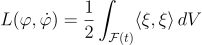
Here,  is the Eulerian velocity field (a vector field on
  ), and
  is the spatial volume form on , which in Cartesian coordinates is
  (or
(or  in 2D).
Particle Relabeling Symmetry
The Lagrangian satisfies particle relabeling symmetry (right-invariance under the action of the diffeomorphism group):

where  are volume-preserving diffeomorphisms. Particle relabeling symmetry expresses the fact that the kinetic energy depends only on the Eulerian velocity field, not on the labels (initial positions) of the fluid particles. This is equivalent to the statement that the physics is invariant under arbitrary reparameterizations of the Lagrangian particle labels.
Mathematically, this means the Lagrangian depends only on the Eulerian velocity:

and not on  itself. This symmetry enables reduction from the tangent bundle
  to the Lie algebra
  , where the Lie algebra consists of all divergence-free vector fields.
Reduced Action
Because of this symmetry, we can reduce the Lagrangian from the tangent bundle  to the Lie algebra
  :
:

where  is the identity element of the group . The action functional over the time interval
  is defined as:
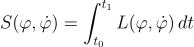
The reduced action becomes:

Lin Constraint (Variations)
Variations of the velocity field  must satisfy the Lin constraint (equivalent to the Euler-Poincaré variation). The variation is given by:
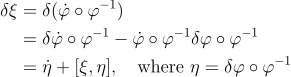
The Lie bracket for vector fields is defined as:

where  represents the variational parameter (variation of the configuration). The boundary terms in the integration by parts will vanish because we assume
  (fixed endpoints) and
  on
on  for a rigid container.
Variation of the Reduced Action
The variation of the reduced action is:
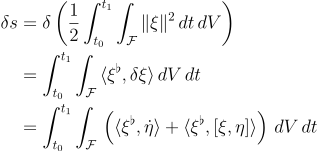
Using the identity for the Lie derivative and the dual pairing:

This identity follows from the Leibniz rule for the Lie derivative acting on the pairing of a 1-form and a vector field.
For a divergence-free vector field, the divergence theorem gives:

Assuming the fluid is contained in a rigid container where  on , the boundary term vanishes.
Therefore:

Euler-Poincaré Equation
Substituting back into the variation:

Integrating by parts in time (assuming vanishes at the endpoints  and
and  ):
):

Thus:

For the variation to vanish for all divergence-free , the term inside the inner product must be  -orthogonal to all divergence-free vector fields. By the Hodge decomposition theorem, it must be an exact 1-form. Thus, we must have:

where  is the pressure 0-form and
  is its exterior derivative (a 1-form) appearing in the equation of motion. The pressure term arises from enforcing the incompressibility constraint via the addition of
  to the action.
Incompressibility Constraint Derivation
The group consists of all diffeomorphisms  that preserve the volume form:

This is the geometric definition of incompressibility in the Lagrangian framework. The Lie algebra consists of all divergence-free vector fields . This incompressibility constraint  follows from the definition of the Lie algebra , where the flow must preserve the volume form.
By Cartan’s magic formula for the Lie derivative of the volume form:

Since is a volume form,  . Thus:

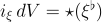
For volume-preserving flows,  . Using the identity
  , we obtain:

This is the geometric form of the incompressibility condition.
Equation of Motion in Coordinate Form
In Cartesian coordinates, we introduce the velocity vector  to represent :

In coordinate notation, the 1-form is represented by the gradient:

And the Lie derivative term becomes the convective term:

(Note that any additional gradient terms produced by the Lie derivative, such as  , are absorbed into the pressure term
  ).
).
The incompressibility constraint becomes:

Thus, the Euler-Poincaré equation in coordinate form reads:

subject to the constraint:

This is the Euler equation for ideal incompressible flow expressed in Cartesian coordinates.